Natural Catastrophes
Climate Change
Volcanic Eruption
Greenhouse Gases Emissions
Climate Adaptation & Resilience
Aerosols & Particulate Matters
Ph.D
United Kingdom
The environmental impact of the 1815 Tambora eruption in 2015
As a result, not only did the mountain go from a height of 4,300 m to 2,850 m, but CO2 was released into the atmosphere in such quantities that it impacted the climate on a global scale. In 1816, several regions of the world experienced a climatic shift, with a temperature drop of a few degrees Celsius, impacting agriculture to such an extent that it caused famine and disease in Europe.
What if such an eruption were to happen in our modern society? This is the question Jessica Kandlbauer is trying to answer through her PhD at the University of Bristol. In order to do so, Kandlbauer is conducting a four-phase research project. First, she investigated historical documents and contemporary literature in order to reconstruct the Tambora eruption. Then, she focused on the volcanology aspect, studying how particles are formed and spread in the air. This will allow Kandlbauer to assess the climate reaction in case a Tambora-style eruption were to happen today. However, she is going beyond the environmental aspect by also examining the socioeconomic aspect of such a disaster.
Do you remember the suspension of all air traffic across Europe due to the 2010 Eyjafjallajökull eruption? This time the situation would be even more problematic in terms of population evacuation, sanitary issues, migratory flows as well as the economic cost of the disaster. Thanks to her research, Kandlbauer aims to develop a model not only of what would happen, but also of what could be planned in order to limit both human casualties and the socioeconomic impact if the Black Swan were to erupt once again.
The main purpose of this research project is to investigate the environmental consequences if an 1815 Tambora-style eruption were to happen today. The project is divided in four main phases, including the synthesis of historical documents and contemporary literature, the volcanological analysis of Tambora ash samples, modelling the global climate response of a possible Tambora eruption today with seasonal variability, and finally the evaluation of the volcanic hazard and vulnerability to assess the environmental and socio-economic impact in SE Asia.
A BLACK SWAN NAMED TAMBORA
To add or modify information on this page, please contact us at the following address: community.research@axa.com

Jessica
KANDLBAUER
Institution
University of Bristol
Country
United Kingdom
Nationality
Swiss
Related articles
Climate Change
Terrestrial Biodiversity
Ice-sheet Melting
Sea-level Rise & Erosion
Mountains, Glaciers, Tundra & Permafrost
Climate Adaptation & Resilience
AXA Project
France
Under Antarctica — A Kite-Ski Science Expedition to Map Ice-Sheet Dynamics
Starting in November 2025, French glaciologist Heidi Sevestre and explorer Matthieu Tordeur will undertake a 3 month unprecedented kite-ski crossing... Read more

Heidi
SEVESTRE
Société des Explorateurs Français
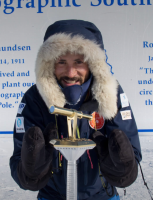
Matthieu
TORDEUR
Société des Explorateurs Français
Climate Change
Finance, Investment & Risk Management
Societal Challenges
Climate Adaptation & Resilience
Insurance & Risk Management
Environmental Justice
Civil Society & Governance
AXA Project
Italy
AXA Research Lab on Climate Change, Risk and Justice
In response to three research questions: How can the private and financial sectors contribute to a just transition to a... Read more

Gianfranco
PELLEGRINO